





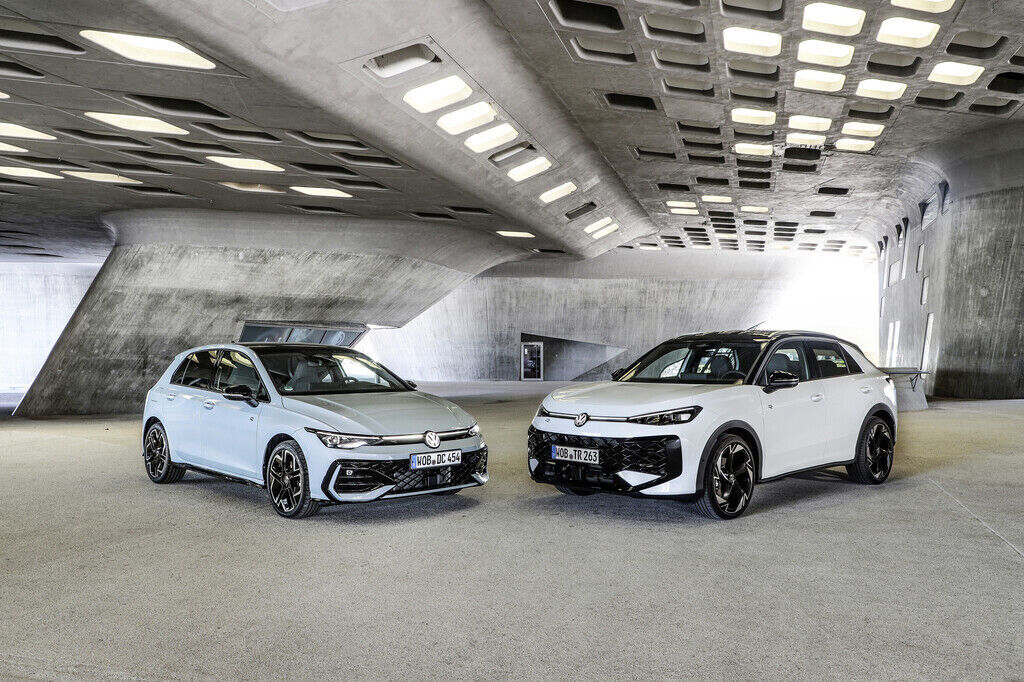
The full hybrid drive offers numerous advantages: compared with a simpler mild hybrid, it enables a higher proportion of electric driving and thus lower emissions and consumption values as well as reduced fuel costs. In comparison with an externally rechargeable plug-in hybrid drive, the purchase costs of the full hybrid are lower, and it requires no charging infrastructure. Taking the Golf as an example, the new hybrid system can be identified by the designation ‘Hybrid’ and closes the gap here between the mild hybrid, which is already available as ‘eTSI’, and the plug-in hybrids. These can be ordered in the Golf under the label ‘eHybrid’2 or as a sporty GTE3. Volkswagen is thus using an even wider spectrum of electrified drive systems, enabling it to offer a suitable drive solution for every usage scenario and every customer in addition to the all-electric ID. models.
Innovative hybrid module.
The new hybrid drive powers the front axle. Its fundamental components are the hybrid module, the turbocharged petrol engine (TSI) and the lithium-ion battery. The hybrid module includes, among other things, an electric motor as the drive motor, a second electric motor as a generator, power electronics, a differential and a one-speed gearbox as well as an electronically controlled multiplate clutch with its own control unit, which is used to engage and disengage the TSI in the drive train. An electric A/C compressor and an electric brake servo are also integrated in the front end. The high-voltage battery, matched to the hybrid drive with NMC cells and with a capacity of 1.6 kWh (gross) usual for HEV vehicles, is integrated into the vehicle floor at the rear of both the Golf and the T-Roc.
Three operating modes.
Volkswagen has designed the interaction between the turbocharged petrol engine (1.5 TSI evo2), two electric motors and high-voltage battery to achieve a good balance of efficiency, dynamics and comfort. The electric motor responsible for the drive power replaces or supports the turbocharged petrol engine in all those phases in which it offers additional efficiency. For example, the Golf Hybrid and T-Roc Hybrid therefore often run on electric power alone, making them very quiet when moving off, at low speeds and thus in urban traffic.
The drive system offers three operating modes that are automatically activated by the vehicle depending on the usage profile:
- Propulsion by electric motor – driving at low speeds powered using the electric motor alone, the TSI is switched off.
- Serial drive – electric motor plus generator: driving with electric motor. The TSI is active but decoupled in order to generate energy for the electric motor via a generator in an optimal operating window and thus extend the electric range.
- Parallel drive – petrol engine and electric motor – the TSI is active as the primary drive system from around 60 km/h on country roads and motorways; the electric motor supports the turbocharged engine, for example, as a booster when accelerating.
Three driving profiles.
The driver will be able to choose between three driving profiles on board the new Golf Hybrid and T-Roc Hybrid: Eco, Comfort and Sport. In the Eco driving profile, the maximum system output is limited to 70 per cent and the boost function is deactivated to reduce energy consumption. The Comfort profile does not limit the system output and allows boosting. In the Sport driving profile, the sporty characteristics are achieved by the drive changing earlier to serial mode so that full power is made available quickly.
1 Near-production concept car. The vehicle is not yet available for sale.
2 Golf eHybrid – Weighted combined energy consumption: 12.8–12.1 kWh/100 km plus 1.3–1.1 l/100 km; combined fuel consumption with discharged battery: 5.3–5.0 l/100 km; weighted combined CO₂ emissions: 29–25 g/km; weighted combined CO₂ class: B; CO₂ class with discharged battery: D–C
3 Golf GTE – Weighted combined energy consumption: 13.0–12.7 kWh/100 km plus 1.4–1.3 l/100 km; combined fuel consumption with discharged battery: 5.4–5.3 l/100 km; weighted combined CO₂ emissions: 31–30 g/km; weighted combined CO₂ class: B; CO₂ class with discharged battery: D
4 T-Roc R-line – fuel consumption combined: 6.0–5.6 l/100 km, CO₂ emissions combined: 136–128 g/km, CO₂ class: E–D