



First Quarter: Volkswagen Group makes progress in a challenging environment – overhead costs reduced by one billion Euro, transformation to be accelerated further


Wolfsburg. On April 30, 2026 the Volkswagen Group will publish the results for the first quarter 2026.
“The world is undergoing fundamental change – and we are aligning our strategy consistently. Wars, geopolitical tensions, trade barriers, stricter regulations, and intense competition are creating headwinds. In this challenging environment, we have managed to make tangible progress. In the Passenger Cars and Light Commercial Vehicles segment, operating profit is up by around 43 percent compared to the previous year. Our product campaign is resonating with our customers. Our cost discipline is paying off. These achievements give us confidence. They form the foundation for further accelerating our transformation. At the same time, the financial result shows that, to improve and sustainably strengthen our competitiveness, we must consistently evolve our business model. We are aligning our products, technologies, and value creation even more closely with regional markets. Above all, our global business gives us decisive advantages in the race for innovation – on our way to becoming the global automotive tech driver.”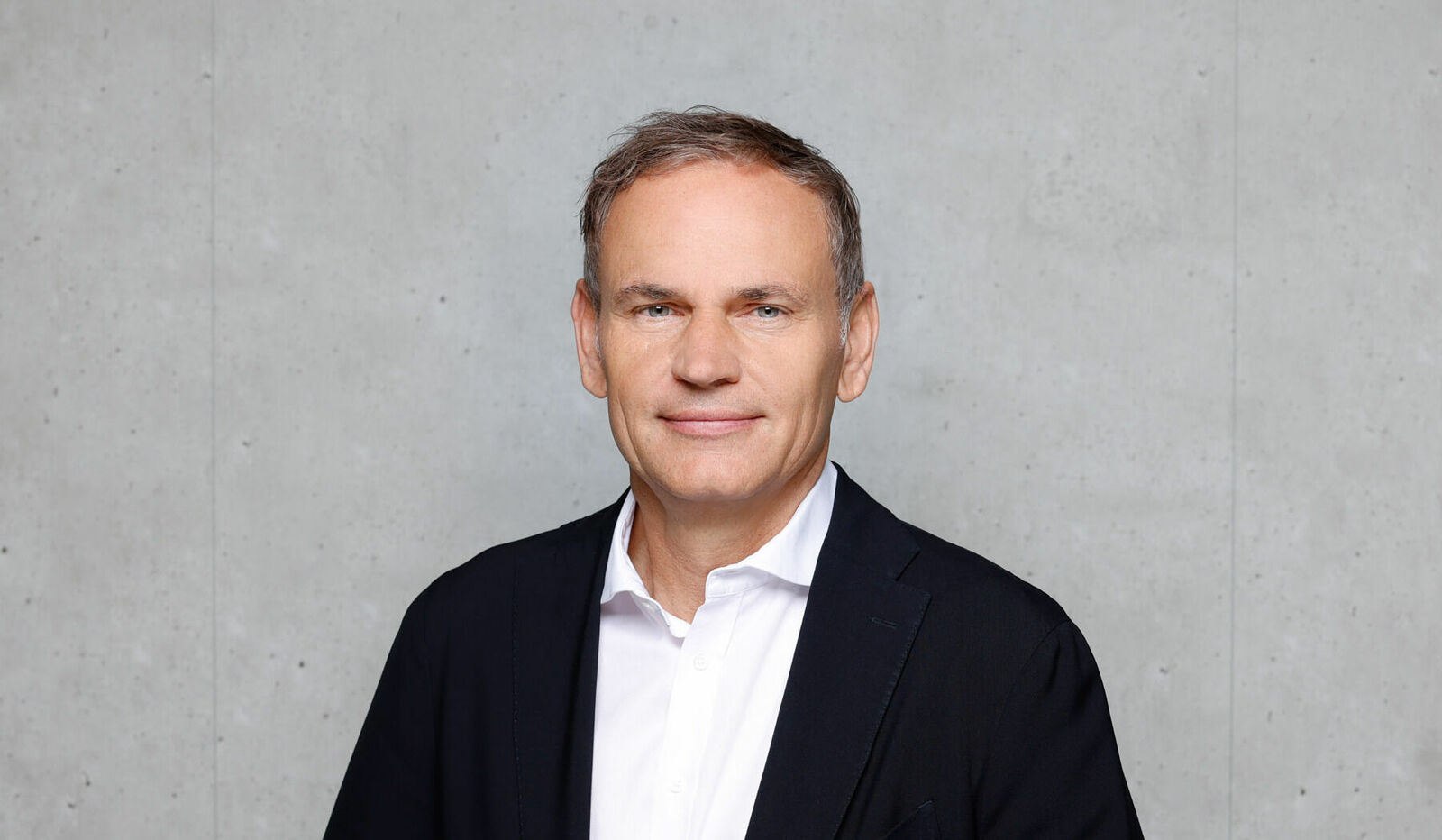
“We made further progress in the first quarter of 2026: order intake in Europe improved, our ‘In China, for China’ strategy is progressing, we reduced overhead costs by nearly 1 billion EUR, and net cash flow reached 2 billion EUR. Despite this progress, our operating margin – even before special effects – remains far too low at 4.3 percent. Since we launched the Volkswagen Future Program one and a half years ago, the world has changed significantly: tariffs have been imposed, competition in China continues to intensify, and Chinese players are increasingly exporting competitive pressure to Europe. In this environment, the planned cost reductions are not enough. We must fundamentally transform our business model and achieve structural, sustainable improvements. This includes improving the cost structure of our vehicles without compromising product substance, significantly reducing overhead costs, increasing the efficiency of our plants, and accelerating technology development and decision-making. We can only achieve this by significantly reducing complexity – in our product portfolio and technology platforms, as well as in the number of entities and decision-making layers. This is what we will focus on in the coming months.”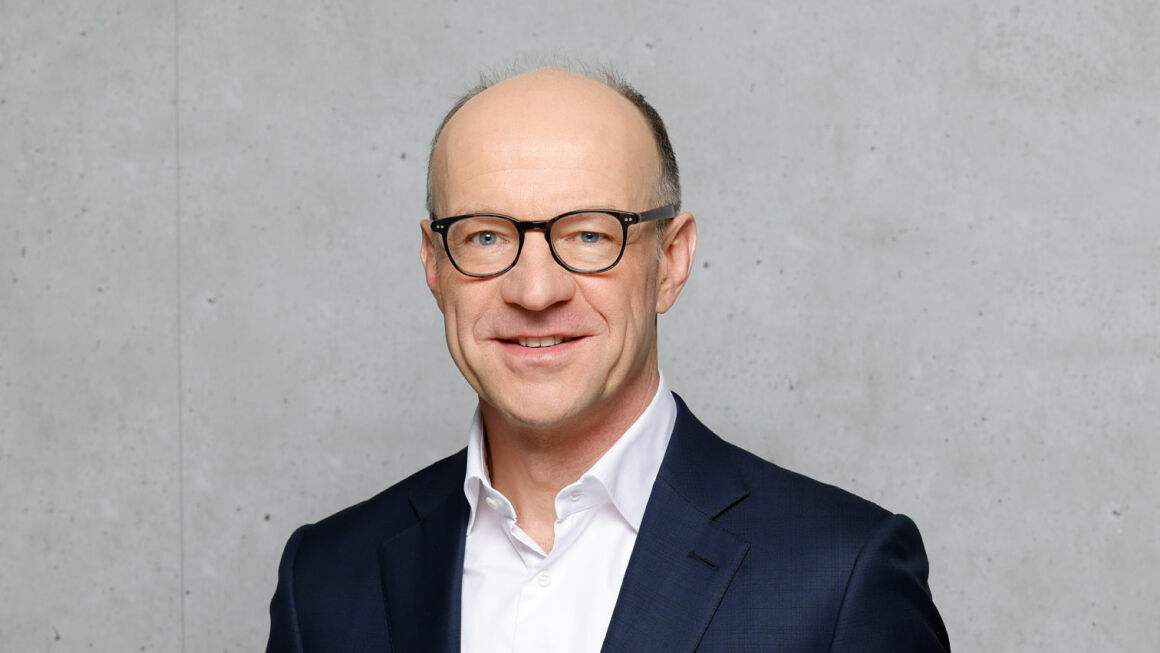
Key Figures
Outlook for 2026
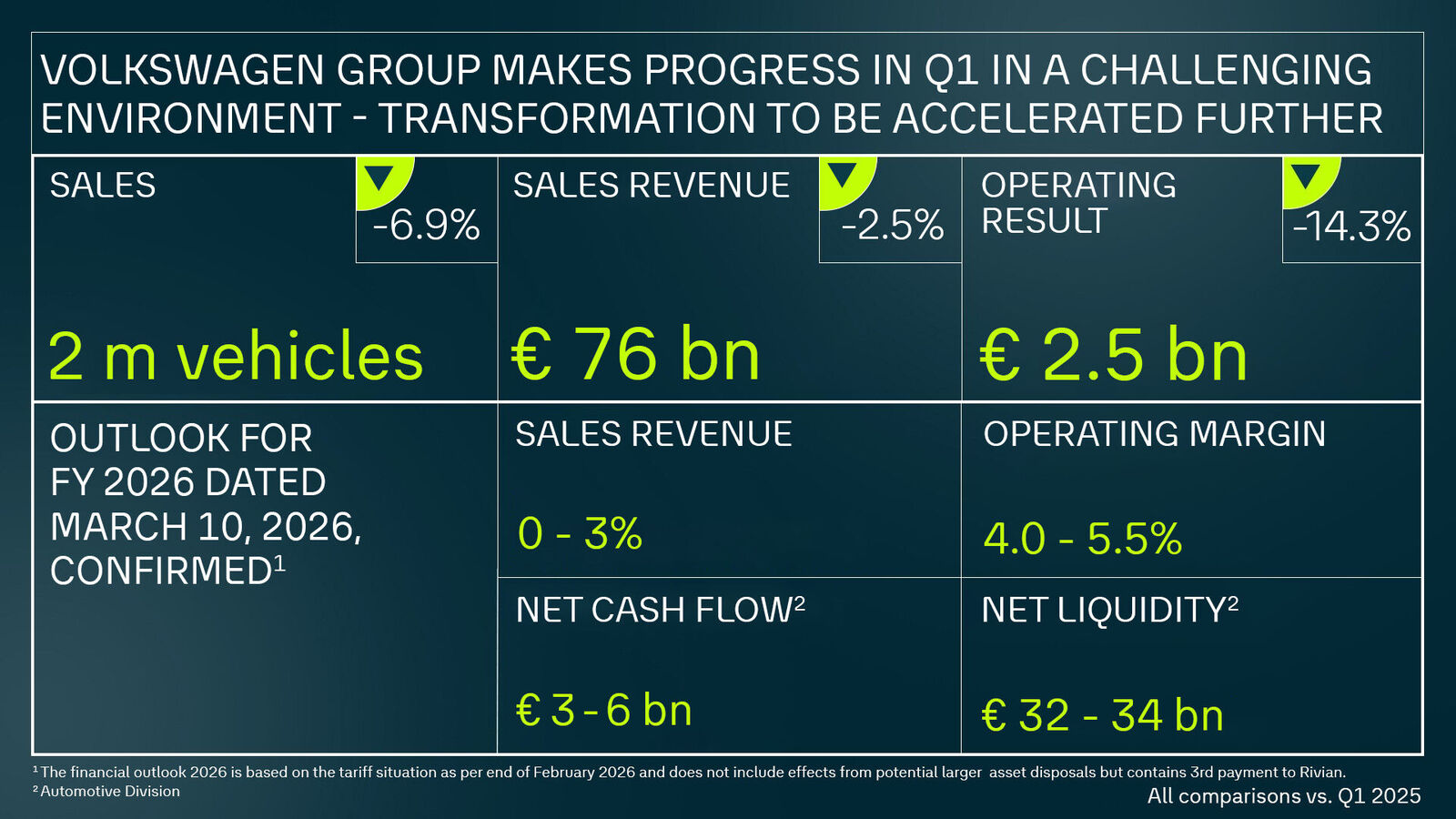
The Volkswagen Group expects sales revenue in 2026 to develop within a range of 0 and +3 percent compared with the previous year. The Group’s operating return on sales is expected to range between 4.0 and 5.5 percent.
In the Automotive Division, the company expects an investment ratio of between 11 and 12 percent in 2026. Net cash flow for the year 2026 is expected to range between EUR 3 billion and EUR 6 billion. Net liquidity in the Automotive Division is expected to range between EUR 32 billion and EUR 34 billion in 2026. The Volkswagen Group continues to pursue its objective of maintaining a solid financing and liquidity policy.
Challenges are expected in particular from the macroeconomic environment, uncertainties regarding restrictions in international trade and geopolitical tensions, increasing competitive intensity, volatile commodity, energy and foreign exchange markets, as well as high requirements resulting from emissions-related regulations.
The forecast is based on the assumption that the current tariff situation in international trade remains unchanged. The potential future impact of an escalation in the Middle East cannot be reliably assessed at present and is therefore not reflected in the forecasted figures.
Further information on the brand groups
Core
Significantly improved operating result of EUR 1.5 billion (+38%). Positive effects from optimized product costs and consistent cost management more than offset the impact from U.S. tariffs and the ID.4 depreciation in the U.S. Vehicle Sales of 1.2 million vehicles and revenue of EUR 34.9 billion at the prior year level; the brand group’s operating margin stood at 4.4%.
Progressive
Revenue declined to EUR 14.2 billion (-8.1%). Operating result at EUR 0.6 billion above prior year (+9.5%). Operating return on sales of 4.2% (+0.7 percentage points). Positive effects from continued cost discipline, lower provisions related to CO₂ regulation, and reduced expenses for restructuring measures. Negative impacts included, among others, U.S. tariffs.
Sport Luxury
Porsche Automotive reported an operating result of EUR 0.5 billion (prior year: EUR 0.7 billion). Main reasons for the decline were lower sales volumes and the impact from U.S. tariffs. The return on sales stood at 7.0%. Revenue fell by 5.6% to EUR 7.4 billion, less than the decline in vehicle sales (–9.5%).
TRATON Group
Volume-driven revenue decline to EUR 9.8 billion (–5.3%). Operating result of EUR 40 million (prior year –EUR 640 million). In addition to lower sales volumes as well as currency and tariff effects, in particular expenses related to adjustments of projects in the field of electric mobility, legal disputes, and charges associated with the agreement to sell a plant of the brand International in the U.S. had a negative impact.
CARIAD
Group Mobility
Operating result of EUR 868 million (–8.5%), due to higher risk provisions. Positive development in new contracts (+2.6%) and in the contract portfolio (+4.2%).
Key Figures Volkswagen Group
Q1 | |||
2026 | 2025 | % | |
Volume Data1 in thousands | |||
Deliveries to customers (units) | 2,049 | 2,134 | -4.0 |
Vehicle sales (units) | 1,954 | 2,100 | -6.9 |
Production (units) | 2,157 | 2,194 | -1.7 |
Employees (on Mar. 31, 2026 / Dec. 31, 2025) | 657.4 | 662.9 | -0.8 |
Financial Data (IFRS), € million | |||
Sales revenue | 75,657 | 77,558 | -2.5 |
Operating result | 2,463 | 2,873 | -14.3 |
Operating return on sales (%) | 3.3 | 3.7 | |
Earnings before tax | 2,235 | 3,109 | -28.4 |
Return on sales before tax (%) | 3.0 | 4.0 | |
Earnings after tax | 1,564 | 2,186 | -28.4 |
Automotive Division | |||
Cash flows from operating activities | 6,662 | 4,696 | +41.9 |
Cash flows from investing activities attributable to operating activities2 | 4,669 | 5,524 | -15.5 |
Net cash flow | 1,993 | -828 | |
Net liquidity at March 31 | 34,237 | 33,180 | 3.2 |
Investment ratio | 11.3 | 11.2 |
1) The figures also include the equity-accounted Chinese joint ventures. Prior-year deliveries have been updated to reflect subsequent statistical trends.
2) Excluding acquisition and disposal of equity investments: Q1 EUR -4,823 (-4,834) million.
Key figures by brand group and divisions from January 1 to March 31
Vehicle sales | Sales revenue | Operating result | Operating margin | |||||
Thousand vehicles/ | 2026 | 2025 | 2026 | 2025 | 2026 | 2025 | 2026 | 2025 |
Core brand group | 1,227 | 1,224 | 34,874 | 35,340 | 1,541 | 1,118 | 4.4 | 3.2 |
Progressive brand group | 260 | 277 | 14,178 | 15,431 | 588 | 537 | 4.2 | 3.5 |
Sport Luxury brand group1 | 59 | 65 | 7,381 | 7,819 | 517 | 678 | 7.0 | 8.7 |
CARIAD | – | – | 389 | 237 | -420 | -755 | – | – |
Battery | – | – | 12 | 2 | -230 | -213 | – | – |
Brand group Trucks | 69 | 73 | 9,780 | 10,326 | 40 | 640 | 0.4 | 6.2 |
Equity-accounted companies in China2 | 494 | 610 | – | – | – | – | – | – |
Volkswagen Group Mobility | – | – | 15,831 | 14,866 | 868 | 948 | 5.5 | 6.4 |
Other3 | -155 | -149 | -6,788 | -6,464 | -441 | -81 | - | - |
Volkswagen Group | 1,954 | 2,100 | 75,657 | 77,558 | 2,463 | 2,873 | 3.3 | 3.7 |
1) Including Porsche Financial Services: sales revenue EUR 8,400 (8,858) million, operating result EUR 595 (762) million.
2) The sales revenue and operating result of the equity-accounted companies in China are not included in the consolidated figures; the share of the operating result generated by these companies amounted to EUR 83 (272) million.
3) In the operating result, mainly intragroup items recognized in profit or loss, in particular from the elimination of intercompany profits; the figure includes depreciation and amortization of identifiable assets as part of purchase price allocation, as well as companies not allocated to the brands.
Overview:
1. How did the Volkswagen Group perform in the first quarter of 2026?
Despite a challenging market environment, the Volkswagen Group made progress, cut overhead costs by nearly €1 billion, and achieved a net cash flow of €2 billion. Operating profit reached €2.5 billion, with an operating margin of 3.3%.
2. What are the key financial figures for Volkswagen Group in Q1 2026?
Revenue totaled €75.7 billion, and vehicle sales reached around 2.0 million units. Growth in Europe and South America partly offset declines in China and North America.
3. What strategy is Volkswagen pursuing after the Q1 2026 results?
Volkswagen is accelerating its transformation through further cost reductions, stronger regional focus, and higher efficiency. The goal is to sustainably improve competitiveness and raise profitability.