Artificial Intelligence in the Automotive Industry
Artificial intelligence in the automotive industry is changing how companies work and how new products and services are created. For the Volkswagen Group, artificial intelligence is a key to greater speed, quality and competitiveness. That is why we are exploring across all areas how AI can improve our products and the way we work.
Wherever we see potential, we utilize artificial intelligence in a targeted manner. Scalable, responsible and with clear industrial benefits. Our ambition: AI everywhere, in every process. Hauke Stars
How we use artificial intelligence at the Volkswagen Group AI supports us in many areas – from vehicle development and production to quality assurance, supply chain management, cybersecurity and autonomous driving. AI is also used in administrative processes and knowledge sharing. More than 1,400 AI applications are already in use across the Group, with hundreds more in development or being implemented.
What are the benefits of AI in the automotive industry?
Innovation in the Automotive Industry
Automotive innovations now have a major impact on vehicle functions and the driving experience. Car-related technology is advancing rapidly. To shape the mobility of tomorrow, the Volkswagen Group is developing solutions in areas such as electric mobility, battery technology, software, artificial intelligence and automated driving.
Our automotive innovations include new vehicle and drivetrain technologies as well as digital solutions across the entire value chain.
How innovations are shaping the car of the future
Software, artificial intelligence , e-mobility and advanced driver assistance systems are at the heart of our vehicle development. They enable new functions and help make vehicles safer, more comfortable and more efficient. They enable new features: Advanced driver-assistance systems enhance active driving safety, while smart software and new battery technologies specifically improve the energy efficiency of our electric models in electric driving mode—compared to earlier vehicle
Error: Your browser does not support the HTML video element and/or MP4 videos. Please upgrade to a recent browser to view this content.
Audi scales up deployment of artificial intelligence in production
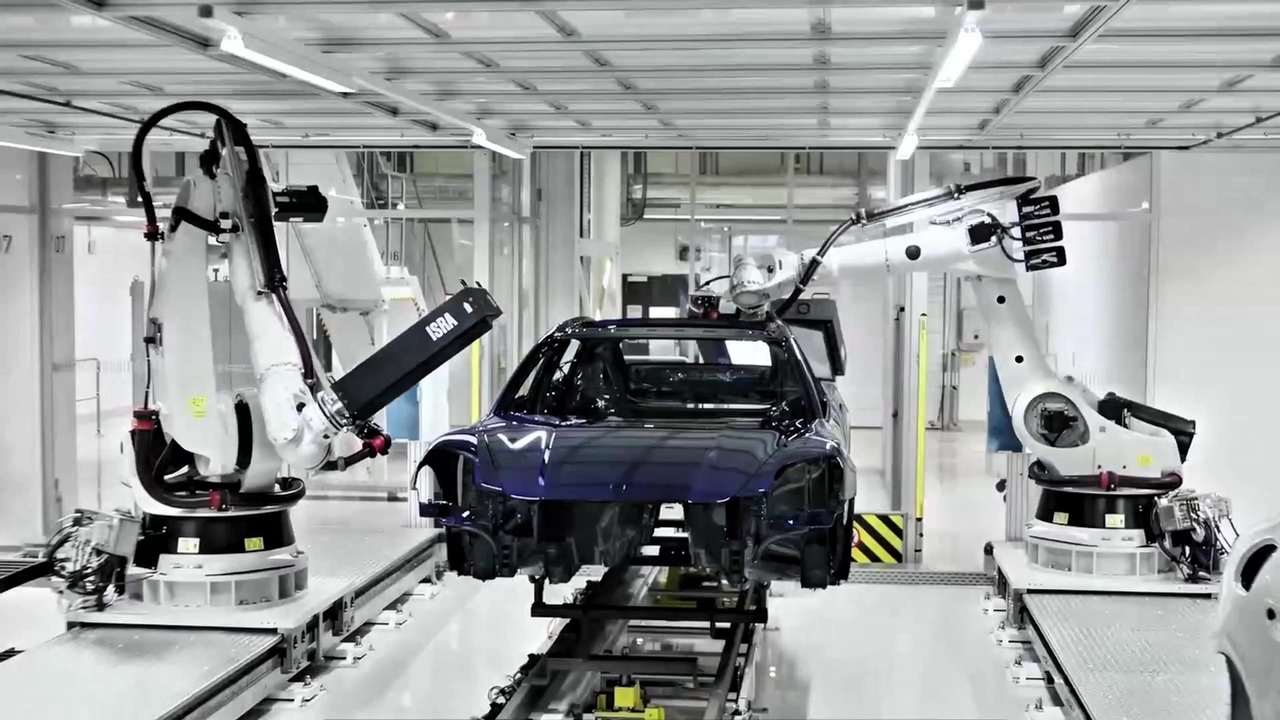
production systems via a large cloud instead of stationary factory computers at scaleGerd Walker, Board Member for Production: “Artificial intelligence is a quantum leap for efficiency in our production. With our AI and digitalization roadmap, we are transforming our plants into smart factories where AI acts as a partner, providing our employees with tailored support.”Partnerships with institutions such as IPAI Heilbronn complement Audi’s innovation strength
Audi is consistently rolling out artificial intelligence (AI) in production and logistics: the company is scaling up its own cloud platform for production and introducing new AI use cases and technologies for large-scale series production. In doing so, the premium manufacturer is relying on the expertise of strong partners. Decades of manufacturing expertise meet smart digital solutions.
“Artificial intelligence is a quantum leap for efficiency in our production. With our AI and digitalization roadmap, we are transforming our plants into
Volkswagen Group establishes artificial intelligence company
Digital products based on artificial intelligence (AI) will play a key role for the Volkswagen Group in the futureVolkswagen intends to simplify collaboration with tech companies and to make optimum use of the AI sector’s innovation potential New “AI Lab” within the Group will act as a globally networked competence center and incubator “AI Lab” will identify new product ideas connected with AI and collaborate with tech companies as the need arises
In the future, digital products based on artificial intelligence (AI) will play a key role for the Volkswagen Group. New infotainment and navigation applications, high-performance speech recognition, extended vehicle functions and the deep integration of digital ecosystems in the car will bring considerable benefits to customers, enhancing the product experience. This is why Volkswagen has established a specialized “AI Lab”. The company will act as a globally networked competence center and incubator. AI Lab will identify new product ideas for
Volkswagen Group expands its competence in artificial intelligence
Group continues to drive the digital transformation forward and is expanding its competence with regard to artificial intelligence (AI), not only with a view to using this key technology in the field of autonomous driving and in production, but also to speed up corporate processes. To that end, Prof. Patrick van der Smagt will be joining the team of AI experts and data scientists at the Volkswagen Group's Data Lab in Munich from October, and will lead the AI team. Van der Smagt is Associate Professor at Technische Universität München and one of Europe's leading experts in deep learning and robotics.
Dr. Martin Hofmann, Chief Information Officer at the Volkswagen Group, commented: "We are delighted that Professor van der Smagt will be joining the Data Lab. This shows how attractive the Volkswagen Group's IT labs are for distinguished scientists and experts in artificial intelligence . Top specialists from Volkswagen, industry partners and the academic world as well as startups jointly develop
"Artificial intelligence is becoming a key competitive factor"
The Volkswagen Group IT Information Technology Center Munich (Data Lab) is the Volkswagen Group's competence center for machine learning and artificial intelligence (AI) Specialists carry out fundamental research and test applications within the Group
How do people think? On what basis do they take decisions? And how can artificial intelligence help them in the future? These questions are being pursued by an international expert team at the Volkswagen Information Technology Center Munich (Data Lab). The team includes IT experts, robotics specialists, data scientists, programmers, physicists and mathematicians, all working hand in hand. Together, they are preparing Volkswagen for the future. On dozens of monitors, code lines, graphs and 3-D diagrams flash across the screen. What you can see here in machine language could help accelerate corporate processes, optimize traffic flows and guide autonomous vehicles safely through the traffic in the future.
"We are developing learning systems
The Car of the Future
car of the future is digitally connected, intelligent and safer than ever before. The Volkswagen Group is promoting the software-defined vehicle.
This means powerful, scalable electronic architectures and software for digitally high-performance vehicles – across all segments.
Automotive mobility of tomorrow – far more than driving
From generative AI in the cockpit to innovative assistance functions: Together with leading technology partners, the brands of the Volkswagen Group are developing services that go far beyond driving. We are simplifying interaction with the vehicle, providing greater comfort for our customers and increasing road safety. In this way, we are shaping the mobility of tomorrow and advancing the development of the car of the future. Examples include our joint venture with US start-up Rivian Automotive and the China Electronic Architecture, developed in cooperation with our Chinese partner Xpeng.
How artificial intelligence is used in the car
When it comes to the
Our People
to culture, origin and language. The degree of internationalization within our top management is part of our Diversity Index, which we measure annually and benchmark against predefined targets.
Our People: We actively support our employees and teams through the transformation
The transformation of the automotive industry is making work at our company increasingly diverse. In addition to traditional engineering and skilled labor roles, digital capabilities, software development and artificial intelligence are becoming increasingly important, while digital business models are increasingly complementing physical products. We want to leverage these opportunities to provide our employees with an attractive and future-oriented working experience and to relieve them of routine tasks. A key priority for us is to actively support our employees through this transformation. Against this backdrop, we invest extensively in qualification and training measures.
Occupational Safety and Health Prevention:
AI-modified